
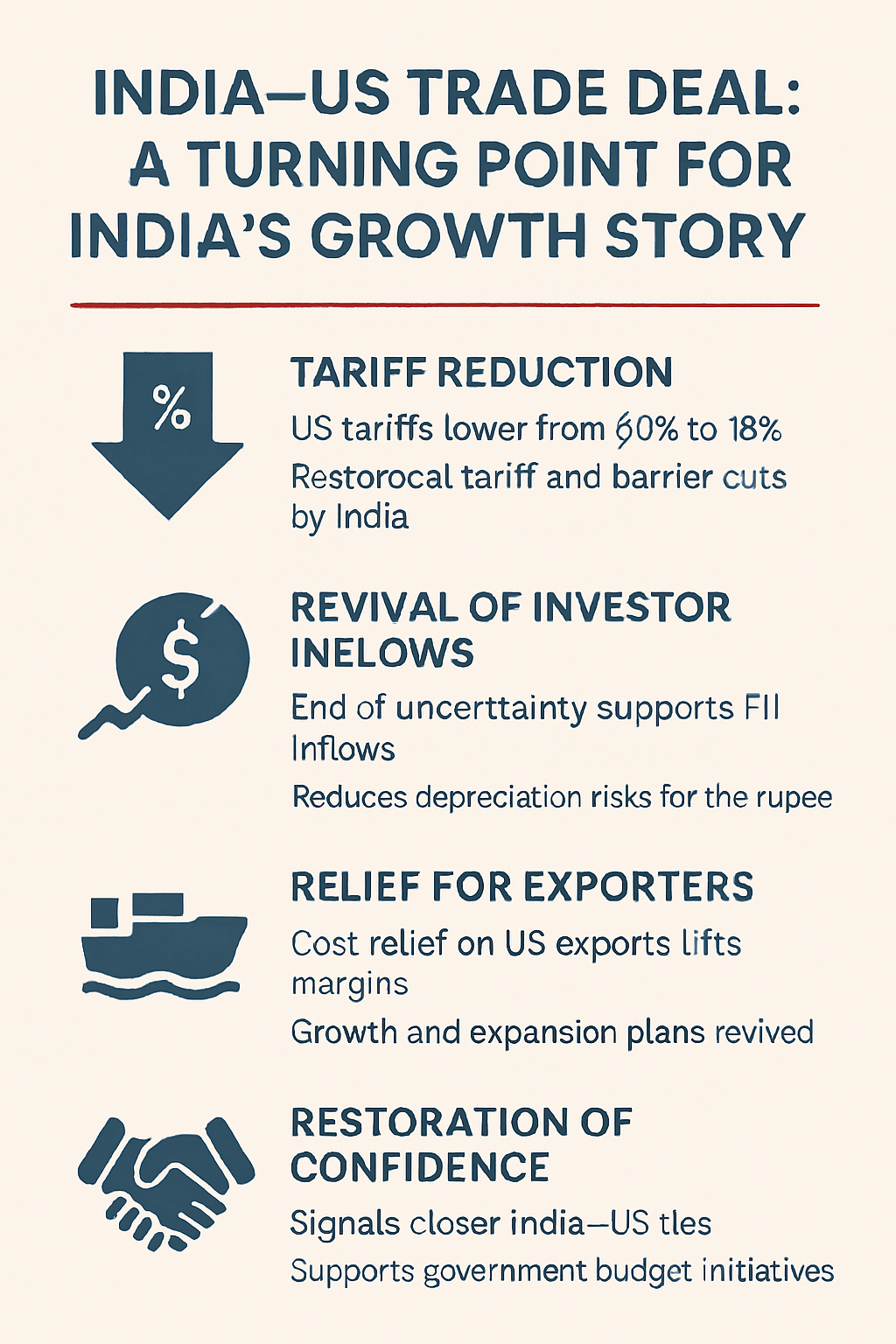
The India–US trade deal reduces tariffs, revives FII inflows, strengthens the rupee, and boosts exporter margins. Discover how this breakthrough reshapes India’s growth story.
The long‑awaited India–US trade deal has finally arrived, and it couldn’t have come at a better time. For months, foreign investors held back, wary of India’s attractiveness as a China+1 destination without a clear agreement in place. Now, with the deal sealed, the uncertainty clouding India’s external position begins to lift.
This breakthrough is more than just about tariffs—it ties directly into the government’s strategic initiatives outlined in the budget. By easing external account pressures, reviving foreign institutional inflows, and reducing depreciation risks for the rupee, the deal strengthens India’s macroeconomic foundation. Improved balance of payments will also support domestic liquidity, creating a healthier environment for businesses and markets alike.
Relief for Exporters and Corporates
Indian exporters had managed to hold their ground in 2025, but only by absorbing heavy tariff costs. The reduction in tariffs now promises real relief, especially on margins. This is likely to benefit the bottom line of companies more than their top line, but the bigger win is the removal of uncertainty—allowing growth and expansion plans to return to the forefront.
Market Sentiment and Liquidity
Equity and fixed‑income markets underperformed their emerging‑market peers last year. The trade deal offers a much‑needed sentiment boost, though a sustainable recovery will still depend on earnings growth. On the currency side, any rupee rebound could spill over into fixed income, partly offsetting the budget‑related G‑sec supply shock. Over the medium term, interest‑rate dynamics will continue to hinge on demand–supply tightness, commodity prices, and inflation trends.
The Tariff Arrangement
Announced jointly by US President Donald Trump and Indian Prime Minister Narendra Modi, the deal reduces US tariffs on Indian goods from 50% to 18%. Reciprocal tariffs on US exports to India are also expected to fall, while the penalty linked to Russian oil imports has reportedly been withdrawn. India, in turn, has agreed to lower barriers on select US imports and committed to large‑scale purchases of American goods across energy, technology, and agriculture. While the $500 billion target looks ambitious compared to India’s $45 billion imports from the US in 2025, the intent signals a deeper economic partnership.
Opportunities and Caution
India now has trade deals with three major blocs—the US, EU, and UK—covering nearly half of global GDP. This is a huge positive for manufacturing and exports, especially with India’s improving business and infrastructure ecosystem. Yet, caution is warranted. Unlike fully binding FTAs, this deal remains flexible, and past episodes remind us that US trade policy can shift quickly. Exporters and policymakers must stay vigilant.
Looking Ahead
The absence of a deal had ironically accelerated India’s reform agenda. Now, with breathing space created, it’s important that policymakers don’t lose sight of the longer‑term goal: making India strategically indispensable in the global economy. The deal restores confidence in India–US relations, supports government initiatives in sectors like semiconductors and data centres, and provides exporters with much‑needed relief.
In short, this trade deal is not just about tariffs—it’s about India reclaiming momentum, strengthening its global positioning, and setting the stage for a more resilient growth story.
What do you think this deal means for India’s future? Share your thoughts below.